You can't campaign your way onto the shortlist.
In 81% of B2B deals, the buyer contacts the vendor at the top of their list first and buys from them. By the time most ABM programs start, the list is already made. Which makes account selection the job, not campaign execution.
In 81% of B2B deals, the buyer contacts the vendor at the top of their shortlist first, and that vendor wins. That figure comes from 6sense’s buyer research.
Read it again. Not contacts first, then decides. Contacts first, and sticks.
The same research found 85% of buyers have their requirements mostly or fully set before they speak to any seller. So the call you think is discovery is usually confirmation.
That changes what ABM is actually for.
The list is made before you show up
Bain and Google surveyed 1,208 people at US companies buying software, cloud hosting, hardware, telecom, logistics, and industrial equipment. Their findings ran in Harvard Business Review. Between 80 and 90% of buyers already had vendors in mind before research began. Roughly 90% bought from that original set. They named it the day one list.
That study is from 2022. Newer numbers say the same thing, louder. 6sense’s 2025 report, covering 4,510 buyers, found the winning vendor sat on the day one list 95% of the time. Nearly 93% of buying teams had prior experience with at least one vendor on their shortlist.
Worth being straight about the sourcing: 6sense sells software that helps companies get onto shortlists, so they have a stake in that number. Bain does not. Both landed in the same place, which is why I trust it.
It also lines up with two things covered here before. Buyers are not walking through your funnel, and the demand you want already exists before you spot it.
Which makes selection the job
Most ABM budget goes to accounts that are in-market. That is the exact moment the list is already set.
This is the awkward part about intent data. Intent tells you an account is shopping. Genuinely useful. But shopping usually starts after the shortlist forms. So intent is good at timing your move on accounts that already know you. It does very little to get you onto a list you were never on.
That is not an argument against intent tools. It is an argument about order. Choose accounts first. Use signals to time the approach.
Signals also behave better in groups. One intent spike is noise. Two or three landing on the same account in a short window is a reason to act.
Here is how I would score an account before it enters a program.
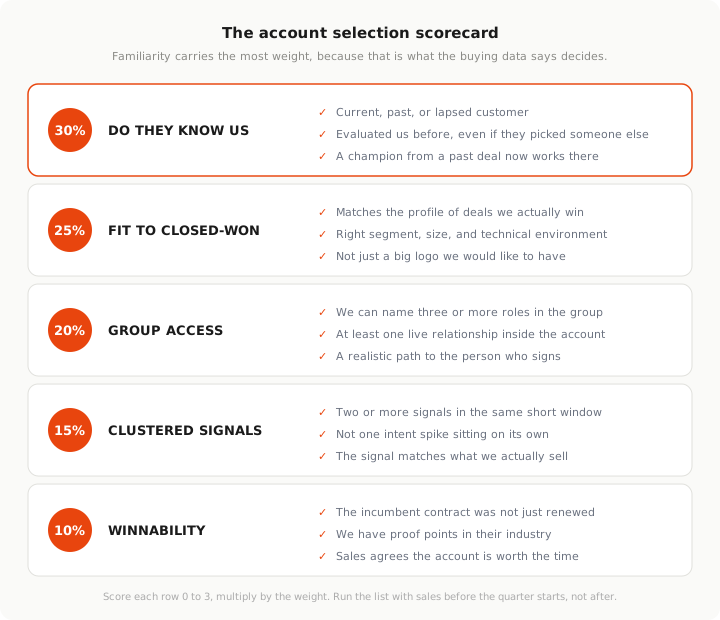
Familiarity carries the most weight because that is what the data says decides. The rest is timing and effort.
Marketing counts people. Buyers buy in groups.
Palo Alto Networks stopped routing on individual leads and started working buying groups, with Forrester supporting the change. Opportunities with more than one person attached were eight times more likely to advance, and the closed-won rate rose 17%. The program won Forrester’s 2025 B2B Program of the Year.
Nothing exotic happened there. They matched their measurement to how buying already worked.
Most ABM reporting still counts contacts. Buyers decide in groups. That gap is where programs quietly fail, and it is a review problem more than a tooling problem. It belongs on a standing meeting with a dashboard, not in a quarterly deck.
The accounts that already know you
Now turn the whole thing around.
If prior experience is what wins, your current customers are the only accounts where prior experience is guaranteed. They have used the product. They know your team. They are already on their own day one list for the next purchase.
Most ABM budget points at strangers.
This is not a plea for retention marketing. It is a selection argument. If familiarity carries 30% of the score, your installed base starts every deal ahead of the field. Whether they stay familiar in a good way is a product question, not a campaign question.
Where AI helps, and where it just adds noise
AI will not write you onto a shortlist.
Where it earns its keep is the part this whole post is about: choosing accounts and mapping groups. Ranking a target list against your closed-won history. Spotting which roles are missing from an open opportunity. Pulling account research that used to cost an analyst a morning.
McKinsey found 88% of organizations use AI somewhere, while only 39% report any earnings impact. The ones seeing returns were about three times more likely to have redesigned the workflow rather than bolting AI onto the old one. Same lesson applies here. AI pointed at a bad account list produces a faster bad list.
Two cautions.
AI personalization reads your CRM. If the fields are stale, it will say something confidently wrong to an account you spent a year earning. That risk sits in the data layer, not the campaign.
And buyers now research through AI before they talk to anyone. Gartner surveyed 646 buyers and found 67% prefer a rep-free experience, with 45% using AI during a recent purchase. So whether an AI names you is now part of how shortlists form.
One more Gartner finding almost nobody quotes: self-service digital purchases are far more likely to end in regret. Buyers want to do it alone, and they do it worse alone. Confident buyers are twice as likely to report a high-quality deal. The move is not to get out of the way. It is to be useful without being in the way.
Big company, small company
Enterprise teams can buy attention. Their real problem is coordination: siloed teams measuring at contact level, so nobody can say which accounts actually moved.
Small teams cannot buy attention. They have to earn it inside a narrow slice of the market. The upside is real, though. A team of four can genuinely run one-to-one on fifty accounts and hold one honest weekly meeting with sales. That coordination is the thing large organizations spend millions trying to buy.
Keep tools last. There are three tiers: what your CRM already does, mid-market platforms such as AdRoll ABM, renamed from RollWorks in August 2025, and enterprise platforms priced accordingly. All of them work. None of them picks your accounts, and none of them makes a stranger familiar.
That order holds in services businesses too, where trust is the product and the stack is just plumbing.
None of this means campaigns do not matter. They matter enormously, for the accounts you chose well.
So the question for your next target list is not how to reach these accounts. It is simpler and harder than that. How many of them already know you exist, and what is the plan for the ones that do not?