Your product is your GTM. The rest is damage control.
ChatGPT hit 100 million users with a URL and a product worth opening twice. The best go-to-market strategy is a product nobody wants to leave.
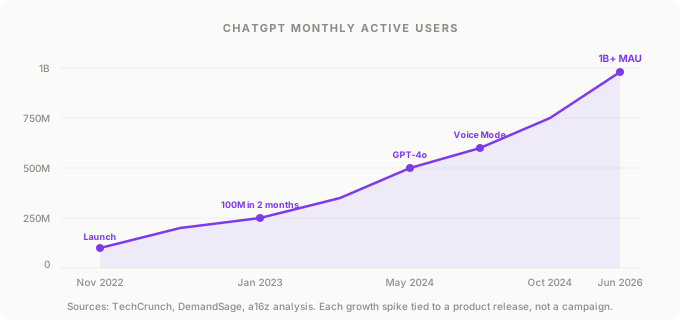
ChatGPT reached 100 million monthly active users in two months. No SDR team. No nurture sequence. No outbound machine. OpenAI’s go-to-market was a URL and a product that answered its own value proposition the moment you typed a question.
That was 2022. By June 2026, ChatGPT crossed one billion monthly active users and $10 billion in annual recurring revenue.
The interesting part isn’t the initial spike. It’s what drove every spike after that. According to a16z’s analysis, each major growth phase tied directly to a product release: GPT-4o in May 2024, Advanced Voice Mode in August 2024, the o1 model series in October 2024. Not a campaign. Not a rebrand. Not a demand gen play. A better product, each time.
The product was the content, the distribution, and the entire go-to-market. Everything else was secondary.
Your CRM is a mirror of your product
Now look at the other side of the spectrum.
Open your marketing automation platform and count the workflows designed to bring people back: winback sequences, re-engagement triggers, churn-save offers. Each one exists because someone used your product and stopped finding value. That’s not GTM working. That’s GTM compensating for something the product didn’t deliver.
The less your CRM has to do to keep customers, the better your product is doing. And the data makes that gap very concrete.
The math behind product-led retention
Bain & Company’s research found that a 5% increase in customer retention produces a 25-95% increase in profits. Harvard Business Review puts the cost of acquiring a new customer at 5-25x more than retaining an existing one.
Those numbers have been around for years. What’s changed is the environment around them.
Customer acquisition costs rose 14% through 2025 while overall SaaS growth slowed. Existing customers now generate 40% of new ARR across B2B SaaS, and over 50% for companies above $50M ARR. The Bessemer Cloud Index shows companies with net revenue retention above 130% trade at 15-20x forward revenue. Below 100%, that drops to 3-5x.
The market already prices product quality into valuation. It just doesn’t call it “GTM.”
Why this matters more now than ever
AI lowered the cost of building. There are more products in every category than there were two years ago. Buyers are using AI to evaluate them faster, compare them more rigorously, and switch with less friction.
A mediocre product with great GTM used to survive. Switching costs were high. Evaluation was slow. Inertia carried renewals. That buffer is disappearing.
6sense’s 2025 research shows that 95% of the time, the winning vendor was already on the buyer’s Day One shortlist before any sales contact happened. 94% of buying groups rank their preferences before initiating a single conversation with a rep. They chose, then they validated.
You can’t GTM your way onto that list with sequences and ad spend. You get there because someone used your product, or someone they trust did, and it was worth remembering.
The uncomfortable question
If you turned off every automated recovery workflow in your CRM tomorrow, how much revenue would you actually lose?
If the answer is “a lot,” that tells you exactly where the real problem sits. It’s not your go-to-market. It’s what you’re selling.
The companies growing fastest right now aren’t the ones with the most sophisticated marketing stack. They’re the ones whose users stay without being asked.
The question worth asking in your next planning cycle isn’t “how do we acquire more?” It’s “why are they leaving?” That’s a product conversation. And the size of your recovery queue is the most honest answer you’ll get.