AI isn't optimizing the funnel. It's dissolving it.
Gartner says your sales rep gets 5% of the buyer's decision-making time. Most teams are trying to make that 5% more efficient. They're solving the wrong problem.
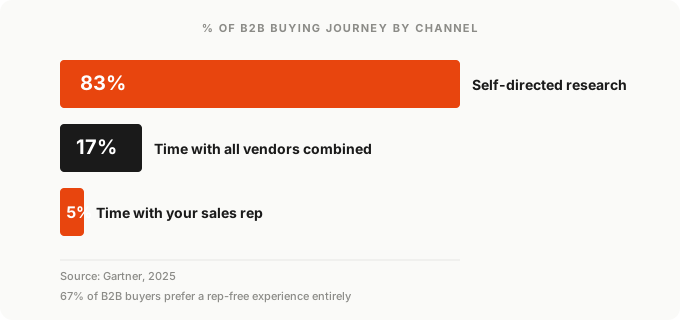
Gartner’s research puts it plainly: B2B buyers spend only 17% of the total purchase journey with any sales rep. Split that across three or four competing vendors, and your team gets roughly 5% of the buyer’s decision-making time.
Most GTM leaders looked at that number and asked how to make their 5% more efficient. Better scripts. Faster follow-up. AI-generated sequences to fill the top of the pipeline.
Wrong problem.
The 5% is a symptom, not the disease
The funnel worked for thirty years because two things were true: attention was scarce, and information was asymmetric. Buyers couldn’t easily compare vendors, parse pricing, or model implementation risk on their own. So we built machinery to move them stage by stage. MQLs, SDR handoffs, nurture tracks, demo requests. Every layer existed because the buyer genuinely needed help moving forward.
Both assumptions broke in the same cycle.
A Gartner survey of 646 B2B buyers found that 45% already used AI during their most recent purchase. In the same study, 67% said they prefer a rep-free buying experience entirely. That’s not a preference trend. That’s a structural shift.
A procurement team running a capable model can now do, in a single afternoon, what used to take a six-week sales cycle: evaluate vendors across twelve dimensions, unpack a pricing page for hidden costs, build an implementation timeline, and draft a list of objections to bring to the demo call. The information gap that justified half your funnel no longer exists.
What replaced the shape
What’s emerging isn’t a narrower funnel. It’s a different structure.
Buyers arrive deep on one dimension and completely cold on another. They’ve read your docs, tested your API, watched a competitor’s teardown video. But they haven’t thought about procurement, and they don’t know your professional services team exists. Each buyer enters at a different point with a different knowledge profile.
The teams still running a linear MQL-to-SQL-to-close motion are forcing a 2026 buyer into a 2014 process. You can feel it in the friction: longer cycles, more ghosting after demos, “great conversation” deals that stall for months.
Where most teams go wrong
The instinct right now is to point AI at the existing funnel: score leads faster, write more sequences, summarize more calls. That automates a shape buyers are actively routing around. You get a marginally faster version of a motion that’s losing relevance by the quarter.
The question worth asking: if buyers can answer most of their own questions before they ever talk to you, what is the GTM org actually for?
My current answer, and it’s a work in progress: the job shifts from manufacturing demand to removing friction from intent that already exists. And from gating information to being the most useful source of it.
That changes what you measure, who you hire, and what “content” even means.
The first team that reorganizes around the 5% reality will have a structural advantage. Everyone else will spend two years wondering why their funnel metrics keep getting noisier.