Your next 1,000 customers will ask an AI first. Does it name you?
Google AI Overviews now appear in 55% of searches. ChatGPT answers 800 million people a week. When a buyer describes their problem to an AI, your product either gets named or it doesn't. There is no page two.
A buyer with a problem used to open Google, scan ten blue links, and click three. Today that same buyer opens ChatGPT, describes the problem in a full sentence, and reads one synthesized answer that names three or four products. The rest do not exist.
Google AI Overviews now appear in roughly 55% of all searches. ChatGPT serves around 800 million people every week. Zero-click searches climbed from 56% in 2024 to 69% in 2025. The search result stopped being a list. It became an answer.
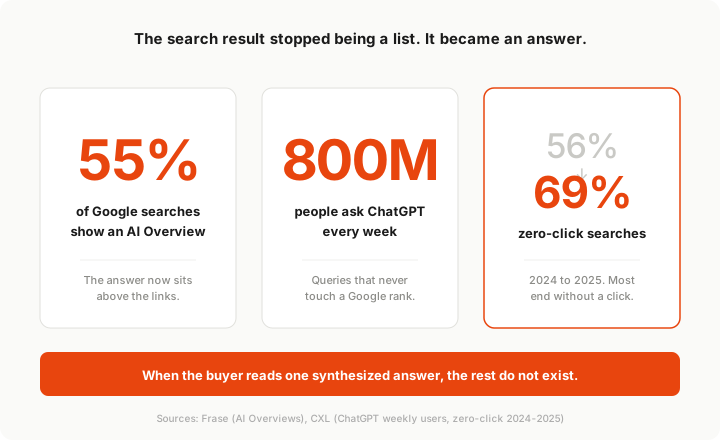
For any founder or marketer, that turns one question into the most important one you will ask this year: when a buyer describes your category to an AI, does your product get named?
A new acronym soup, and a correction from the one company that matters
An entire discipline formed around this question almost overnight. AEO, answer engine optimization, means structuring content so an AI selects it as the answer. GEO, generative engine optimization, means earning citations inside generative responses. The advice converged fast across Frase, CXL, HubSpot, Forrester, and PwC: write question-led content, answer in the first sentence, add FAQ and Article schema, build entity authority.
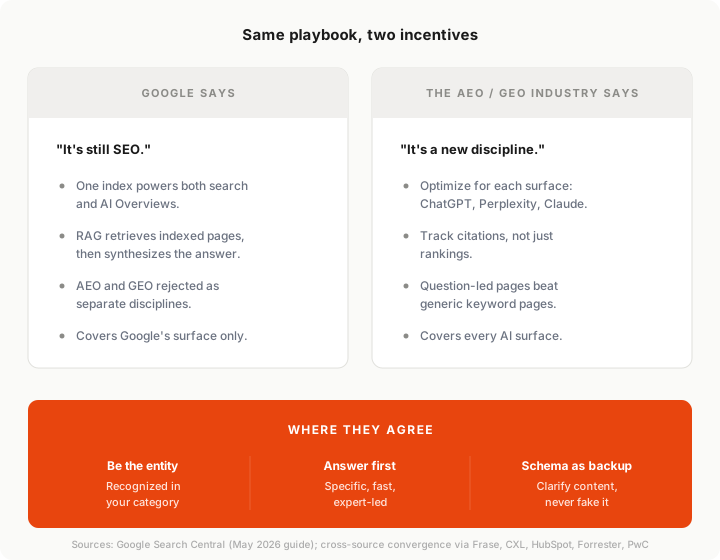
Then, on May 15, 2026, Google published its first official guide to optimizing for generative AI features. The position was blunt. From Google Search’s perspective, optimizing for generative AI search is optimizing for the search experience, and thus still SEO. The guide explicitly rejects AEO and GEO as distinct disciplines and folds the entire effort back into the fundamentals.
So who is right? The industry selling a new playbook, or the company that owns 55% of the surface?
The answer matters more than the argument, and it is more useful than either side admits.
Why Google says “it’s still SEO”
Google’s claim rests on one technical fact. AI Overviews and AI Mode draw from the same index that powers traditional search. There is no separate “AI index” or “AI ranking algorithm.” The generative layer sits on top of retrieval, a method called RAG, where the model pulls indexed pages and synthesizes an answer from them rather than inventing one.
If the AI is reading from the same index, then the work that gets you into that index is the work you already know. Content has to be crawlable, indexable, and pass the basic technical requirements before any “AI optimization” matters at all. That is the entry ticket. Nothing exotic earns it.
There is also a behavior worth understanding. When someone types a conversational query, Google fans it out into a cluster of related searches running concurrently, then combines the results. A question about fixing a weed-filled lawn quietly becomes several searches about herbicides, chemical-free removal, and prevention, all at once. Your page does not need to win one query. It needs to be credible across the whole constellation.
That is a meaningful reframe. The target is no longer a keyword. It is a topic, covered well enough that you surface no matter how the buyer phrases the problem.
Where Google is right, and where the AEO crowd is too
Strip away the acronym fight and the two camps agree on more than they admit.
Google is right that there is no secret AI ranking lever. The company’s own advice is almost stubbornly plain: creating content that people find unique, compelling, and useful will influence your presence in generative AI search more than any other suggestion in the guide. Non-commodity, first-hand, expert-led content with a unique perspective performs best. Generic summaries and keyword-stuffed pages do not. Google even names what to ignore: llms.txt files, mechanical content chunking, AI-specific rewriting, and inauthentic brand mentions.
The AEO practitioners are right about the part Google leaves out. Google speaks only for its own surface. It says nothing about how ChatGPT, Perplexity, or Claude select what to mention, and those answer a combined billion-plus queries that never touch a Google ranking. On those surfaces, the patterns that keep showing up across independent analyses are consistent: question-led pages beat generic keyword pages, fast and specific answers get extracted, and answer engines prefer trustworthy, attributable, well-structured sources.
Notice that these are not two different playbooks. They are the same playbook described by two parties with different incentives. The convergence is the signal.
What actually moves the needle
For a funded startup building a solution in any category, the work sorts into three layers. None of them is new. The order is what changed.
Be the entity, not the keyword. AI systems process the world as entities: organizations, products, people, and the relationships between them. They identify your company as a thing of a known type, not as a string of matched words. The practical implication for a young company is uncomfortable. If the model has never encountered your product as a recognized entity in your category, it cannot name you, no matter how good your landing page is. Consistent description of who you are and what problem you solve, repeated across your own site and credible third-party sources, is what builds that recognition.
Answer the real question, first. The single most repeated finding across every credible source is the most boring one. Pages that answer a specific question quickly and directly have far better odds of being extracted. Lead with the answer, then support it. This is also exactly what Google’s E-E-A-T framework rewards: first-hand experience, demonstrated expertise, and authoritative sourcing. The same content satisfies both the AI answer layer and traditional ranking, because they now run on the same signals.
Use schema as reinforcement, not as a trick. Structured data helps machines classify your page’s purpose and entities faster. FAQ, Article, Product, and Organization markup are the practical starting points. But the caution is firm: structured data should clarify what a user can already see, never invent claims the page does not support. Schema that contradicts your visible content creates trust problems, not visibility. Schema is an amplifier for clear content. It cannot rescue thin content.
The part nobody is comfortable saying
Here is what connects all of it. Every credible source, including Google, eventually arrives at the same destination: the content has to be genuinely good, genuinely expert, and genuinely useful, or none of the technical work matters.
That sounds like a platitude until you sit with the consequence. The AI is a quality filter with no patience for the tactics that propped up mediocre content for two decades. You cannot keyword-stuff your way into an AI Overview. You cannot buy your way into a ChatGPT recommendation. The synthesis layer reads everything and names the source that best, most credibly answers the question. The optimization and the product have collapsed into the same problem.
NerdWallet offers the clearest proof. It held revenue growth even as raw traffic fell, by being the expert answer across multiple platforms rather than chasing clicks on one. The traffic shape changed. The authority compounded.
So the question to bring to your next content review is not “how do we optimize for AEO?” It is sharper than that. When a buyer in your category describes their problem to an AI tomorrow morning, what would have to be true for your product to be the one it names?