RevOps already knows how to manage AI. It's called pipeline.
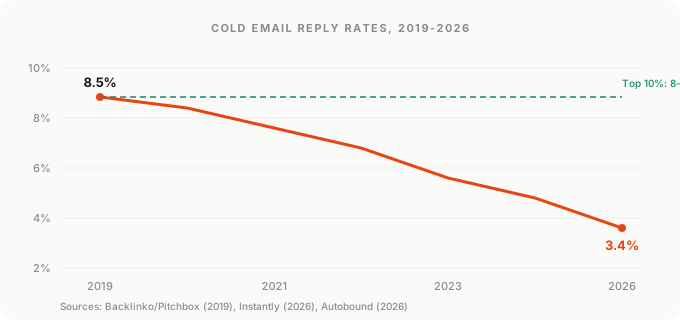
Cold email reply rates dropped from 8.5% to 3.4% in five years. Most teams blame the channel. The real problem: nobody's measuring whether their AI is helping or just producing plausible text at scale.
Outreach shipped its AI email writer. Salesloft followed. Then Apollo, Instantly, Lavender, and a dozen others. By mid-2025, most B2B outbound teams were running AI-drafted sequences at scale.
Over the same period, cold email reply rates declined sharply. A Backlinko/Pitchbox analysis of 12 million outreach emails found an average reply rate of 8.5%. By 2026, Instantly’s benchmark data across billions of cold sends puts the average at 3.4%.
The instinct is to blame the channel. “Cold email is dying.” But the top 10% of outbound campaigns still hit 8-12% reply rates consistently. That’s a wide gap between the best and the worst, and the difference isn’t the model they’re using. It’s whether they’re measuring the output.
This is the anxiety running through every GTM org that adopted AI for outbound: we deployed it, we scaled it, and we genuinely don’t know if it’s helping or just producing plausible text faster.
RevOps solved this exact problem years ago. The muscle just needs a new application.
Evals are pipeline reviews
An “eval” in AI terms is a repeatable test that scores model output against a clear definition of good. Define the outcome. Instrument it. Review the trend. Intervene when it drifts.
That’s a pipeline review.
RevOps spent a decade building this muscle. “The deal feels good” doesn’t pass a pipeline review. You define stage exit criteria. You instrument conversion rates instead of eyeballing the forecast. And you review weekly, catching drift before it compounds.
Apply that same rigor to AI output and the “black box” opens up.
What this looks like in practice
Take the outbound email case. The difference between guessing and running evals:
Guessing: “The AI writes our emails now. They seem fine.”
Running evals:
- Define good. Reply rate, positive reply rate, and meetings booked. Not “sounds human.”
- Instrument. Tag every AI-drafted message separately from human-drafted. Same segments, same time window, same ICP.
- Review weekly. Is the AI cohort converging with human performance? Widening the gap? Where does it consistently fail?
- Intervene. Adjust the prompt, the context data fed to the model, or the boundary of what AI owns versus what a rep handles directly.
The data already shows that measurement matters. Signal-based outreach that incorporates prospect-specific context achieves reply rates of 5-10x the generic average, according to Autobound’s analysis of campaign performance data. The gap isn’t the model. It’s whether anyone is watching the output and tuning the inputs.
Why RevOps should own this
The teams that win the AI transition won’t be the ones with the best models. They’ll be the ones who already had the discipline to measure outcomes and intervene on drift.
RevOps already operates this way. The opportunity is recognizing that “managing AI output” and “running pipeline” are the same job pointed at different data.
The question nobody’s asking yet: what does the weekly AI review meeting actually look like? Who runs it? What’s on the dashboard? What triggers an intervention? That’s the next thing worth building.